Why don’t I want others to have what I don’t even want
A colleague takes a job you turned down, and it stings. A friend borrows a jacket you never wear, and suddenly you want it back. You had no use for either. Still, the moment someone else reaches for them, you feel a pull to say no.
This feeling is difficult to justify, so it usually remains unspoken.
The dog in the manger
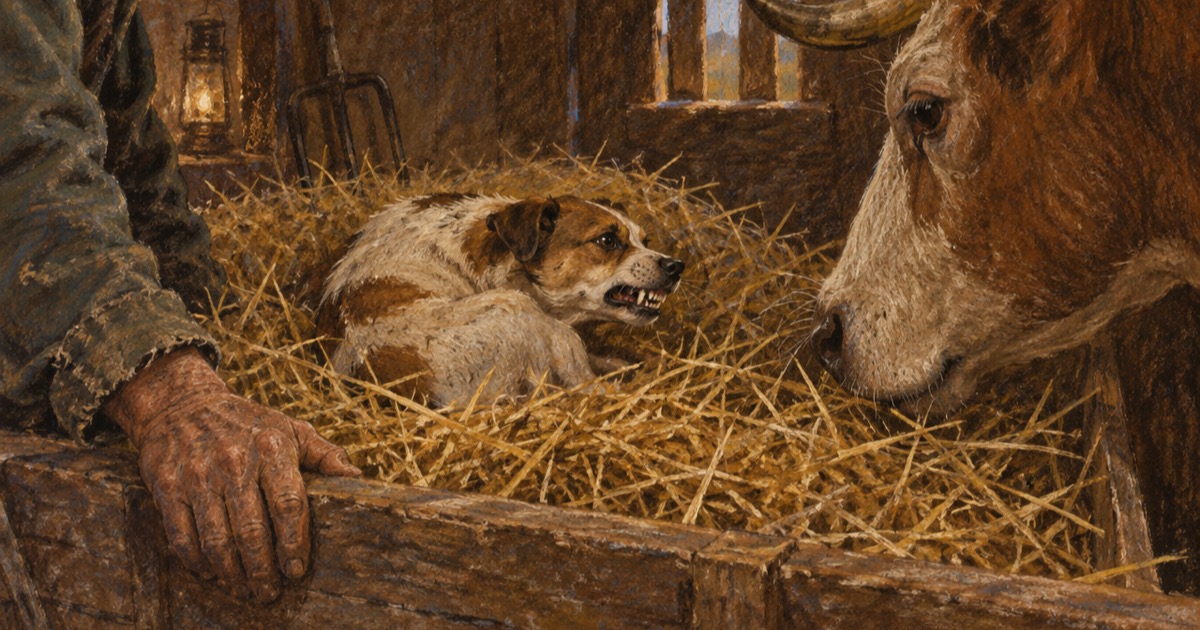
Aesop wrote a fable about this. A dog settles into a manger full of hay. Dogs do not eat hay, but the hungry oxen do.
“A Dog lay in a manger, and by his growling and snapping prevented the oxen from eating the hay which had been placed for them.”
— Aesop, “The Dog in the Manger”, Three Hundred Æsop’s Fables, tr. George Fyler Townsend, George Routledge and Sons, 1867
One ox calls the dog selfish. The dog gains nothing from this; it does not eat the hay. It simply occupies the space.
Guarding the place
The hay is useless to the dog. What it guards is the manger and its own position in it. While the dog lies there, the place is its own. When an ox eats, the place belongs to the ox.
The job and the jacket function similarly. You did not want the things themselves. You wanted to remain the person they belonged to, the one who could have had them. When they go to someone else, nothing leaves your life, because they were never in it. What vanishes is a piece of your identity: the version of you whose place this was.
What the oxen take away
What would I lose if someone else got what I don’t want myself?
Epimelea is an app built around the existential school. The conversation carries over from one meeting to the next. The archive is encrypted on the device and belongs to the person who wrote it.
About the app: an AI therapist for long-term therapy
This page is about a school of psychotherapy. It is not medical advice and not emergency help. If you are in danger right now, contact your local emergency number, or find a helpline in your country at findahelpline.com.


The first two meetings are free.