Why can't I watch someone work without telling them how?
A partner assembles a shelf. You sit on the sofa, holding a book you stopped reading pages ago. The screws enter at an angle. Within a minute, you are standing beside them, holding the instructions, then the screwdriver. No one asked for help. The shelf would likely stand either way.
The offer to pack
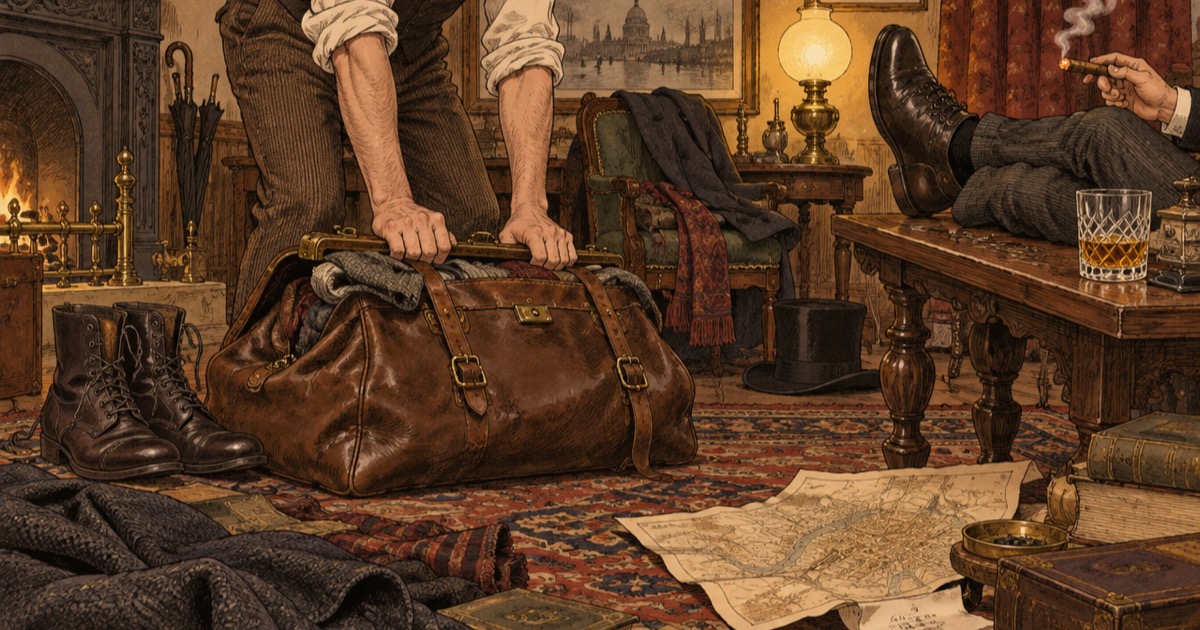
In chapter four of Three Men in a Boat (1889), the narrator J. announces he will handle the packing for the trip. He expects his friends to protest. Instead, Harris and George accept immediately. George settles into an easy chair with a pipe; Harris puts his legs on the table and lights a cigar.
J. is put out. He had pictured something else entirely:
"What I had meant, of course, was, that I should boss the job"
— Jerome K. Jerome, Three Men in a Boat (To Say Nothing of the Dog), chapter IV (1889)
The plan was that Harris and George would potter about under his directions while he pushed them aside with "Here, let me do it." When they simply sit and watch, the packing stops being what he wanted.
The energetic nature
A page later, J. explains himself. He cannot sit still while another man is working. He wants to get up, walk round with his hands in his pockets and tell him what to do. "It is my energetic nature," he adds, and then: "I can't help it."
The joke is gentle, and Jerome lets J. tell it against himself. Notice what the energy consists of, though. Walking round with hands in pockets. The energy goes into the other man's task, and none of it into the hands.
Then J. packs alone, straps the bag and sits on it. Harris asks whether he means to put the boots in. A moment later J. cannot remember whether he packed his toothbrush.
Uncle Podger and the picture
One chapter earlier, Jerome tells of Uncle Podger hanging a picture. One nail, one frame, and the whole household is sent running for the hammer, the rule, the stepladder and a candle. "You never saw such a commotion up and down a house," the book says. Jerome makes the comparison to Harris, not to J. Yet the scene sits close to the packing. In both, one man's job turns into everyone's job, and the man himself is somehow the last to be doing it.
Inside someone else's work
Directing has an odd comfort. While I tell my partner how to hold the screwdriver, I am part of the shelf. I am no longer the person on the sofa with a book I put down, or with whatever I left half-finished in the next room.
J. could hardly bear Harris and George sitting idle. Their stillness left him alone with the bag, and with his own forgotten boots.
The next time my hands reach for someone else's screwdriver, what is it I would have to feel if I stayed on the sofa?
Epimelea is an app built around the existential school. The conversation carries over from one meeting to the next. The archive is encrypted on the device and belongs to the person who wrote it.
About the app: an AI therapist for long-term therapy
This page is about a school of psychotherapy. It is not medical advice and not emergency help. If you are in danger right now, contact your local emergency number, or find a helpline in your country at findahelpline.com.

