Why do I act like an idiot every time I go into a bank?
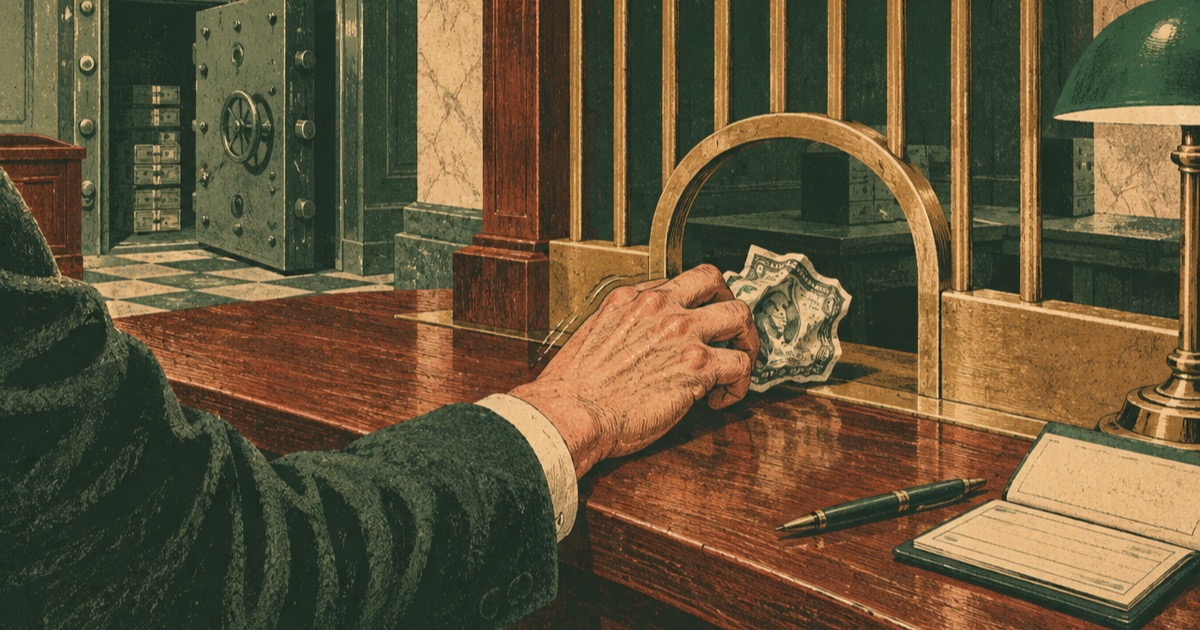
I need to adjust a single detail on my account. At home, the request takes one sentence. At the counter, I hand over the wrong card and sign in the box labeled “for bank use only.” The teller asks if I meant to open a second account. I did not. I say yes. Ten minutes later, I am outside with that new account, and walking back in to correct the error feels harder than leaving it as is.
Fifty-six dollars and a locked door
In Stephen Leacock’s story “My Financial Career,” the narrator finds the bank overwhelming. The clerks, windows, and money rattle him. His salary has just risen to fifty dollars a month, so he decides the bank is the only place for it.
He assumes opening an account requires the manager. He asks to see him alone, then asks again. The manager leads him to a private room, locks the door, and asks if he is a Pinkerton detective. When the narrator says he has come to open an account, the manager decides he must be a son of Baron Rothschild. The sum is fifty-six dollars. The manager calls the accountant with the news, and the narrator leaves through the wrong door, straight into the safe.
The check for the whole amount
At the counter, he deposits the money and asks for a check. He means to withdraw six dollars to spend. He writes fifty-six. The clerk stares, asking if he is drawing it all out again, while all the clerks stop writing to look at him.
“I had a feeling that it was impossible to explain the thing.”
— Stephen Leacock, “My Financial Career”, Literary Lapses (Wikisource)
So he says yes, every cent, and never again. He tries to look like a man with a quick temper who has just been offended. The clerk asks how he wants it. In fifties, he says. And the six? In sixes. He takes the money and rushes out. As the big door swings shut behind him, he hears a roar of laughter. He has not used a bank since. His money stays in his trouser pocket, his savings in a sock. The clerk’s question hands him a role, which he takes.
Playing the part he was handed
He even tries to play it well: the quick temper, the fifties, the sixes. The only way out of the role is one plain sentence: I wrote the wrong number. That admission costs more than the account.
What exactly would I have to admit if I simply explained the first mistake?
Epimelea is an app built around the existential school. The conversation carries over from one meeting to the next. The archive is encrypted on the device and belongs to the person who wrote it.
About the app: an AI therapist for long-term therapy
This page is about a school of psychotherapy. It is not medical advice and not emergency help. If you are in danger right now, contact your local emergency number, or find a helpline in your country at findahelpline.com.

