Why do I enjoy a game more when I play it badly?
For six years, I have played chess at a local café on Tuesday evenings. I lose roughly two out of every three games, yet those nights remain my favorite part of the week. My friend Daniel started the same year. He now spends his commute reading opening theory and playing timed matches on his phone. He talks about his rating. When he loses a game, he stays silent for the rest of the evening. Last week, he offered to teach me a proper defense. I refused quickly, faster than I intended. I have been thinking about that reaction ever since.
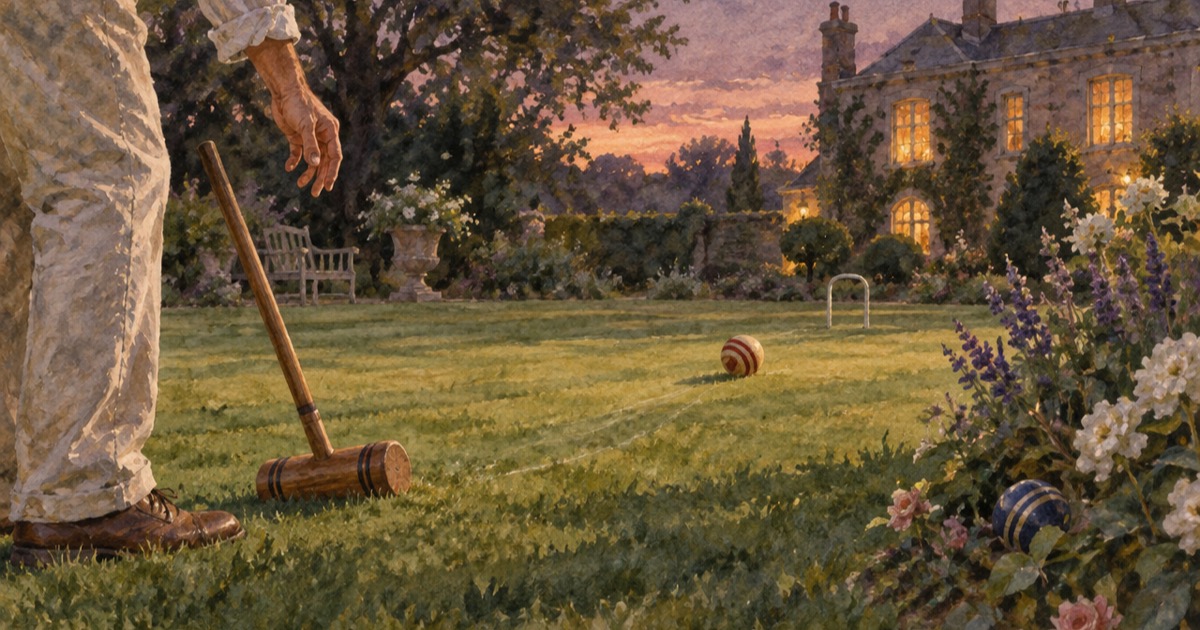
Croquet at dusk
G. K. Chesterton tells the story in “The Perfect Game,” an essay published in Tremendous Trifles in 1909. He describes a blue, burning summer afternoon when he plays croquet with a man he calls Parkinson. Chesterton has the worst of the game all along and, he believes, the best of the argument.
Parkinson plays well. Because of his skill, he loves glory and applause. Chesterton plays badly. This makes him the one who loves the game itself:
“It is only we who play badly who love the Game itself.”
— G. K. Chesterton, “The Perfect Game,” Tremendous Trifles (London: Methuen, 1909), pp. 17–22 (Wikisource)
Chesterton extends the logic to other arts. The good painter loves his skill, and the bad painter loves his art. The good musician loves being a musician, and the bad one loves music.
The other side of the lawn
Parkinson does not sulk. He argues that the more a person likes a game, the better he would want to play it. He uses Chesterton’s own metaphor of a knight devoted to his lady: of course the knight wants to be near her, but nobody ever heard of one who wanted to look an utter ass when he got there. Chesterton replies that love grows without limit, but a game does not. If he could hit the ball through a distant hoop as easily as picking it up by hand, the act would lose its value. “The moment the game is perfect the game disappears.”
Darkness falls. Parkinson says he cannot see anything. Chesterton swings into the dusk and hits the correct ball. His ball passes through a hoop he cannot see. Then it strikes the stick. He throws down his mallet, saying he cannot stand it. Parkinson tells him to pick it up and try again. Perhaps, he suggests, fairies are teasing him by sending the perfect game, which is no game at all. Chesterton takes one final shot and runs inside.
Three shots in the dark
Chesterton tells this joke against himself. He believes he has won the argument, yet three successful shots in a row are enough to drive him off the lawn while Parkinson’s counterpoint remains unresolved.
Playing badly can be a real way of loving something. The evening stays light when there is nothing to prove and no rating to protect. It can also serve as a shelter. As long as I lose without trying, nobody asks if I could try harder and still fail. I do not ask myself that question either. By his own theory, perfect strokes should have bored Chesterton. Instead, he ran away.
When Daniel offered to teach me the defense, I heard a question behind the lesson: would my Tuesday nights still be mine if I started caring about winning them?
What would I lose if I started doing well the thing I love doing badly?
Epimelea is an app built around the existential school. The conversation carries over from one meeting to the next. The archive is encrypted on the device and belongs to the person who wrote it.
About the app: an AI therapist for long-term therapy
This page is about a school of psychotherapy. It is not medical advice and not emergency help. If you are in danger right now, contact your local emergency number, or find a helpline in your country at findahelpline.com.

