Why do I follow whoever sounds most sure of himself?
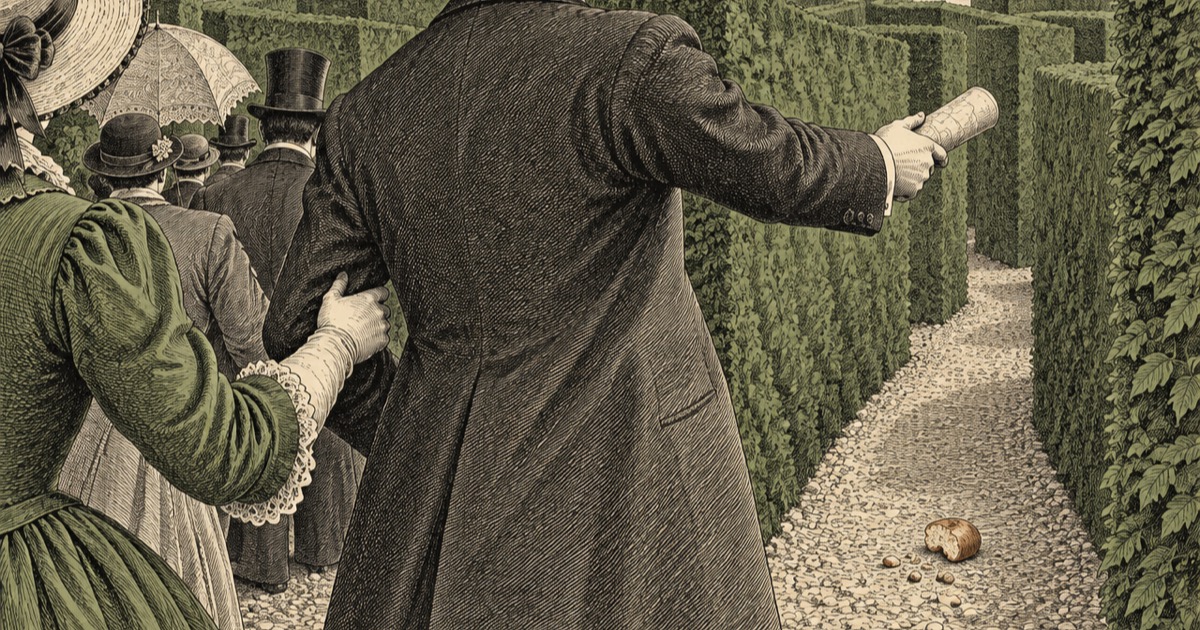
I drove around an unfamiliar town for forty minutes, searching for a hotel. My phone had no signal. At a petrol station, a man in the queue overheard me asking for directions. Without hesitation, he told me to go two lights down and turn left at the church. I thanked him and left. There was no church. I kept driving anyway. His certainty felt like a relief, and following instructions was easier than navigating alone.
A map that seemed too simple
In Chapter 6 of Three Men in a Boat (1889), Jerome K. Jerome has Harris tell the story of the Hampton Court maze. Harris had studied the map, which looked so simple it seemed almost silly, hardly worth the twopence admission; he brought a country cousin with him and promised ten minutes of walking, followed by lunch. The rule was to keep taking the first turning to the right.
Inside, they met people who had been wandering for three-quarters of an hour and were ready to give up. Harris offered them a way out:
“Harris told them they could follow him, if they liked; he was just going in, and then should turn round and come out again.”
— Jerome K. Jerome, Three Men in a Boat (To Say Nothing of the Dog) (1889), Chapter VI (Wikisource/Chapter_6))
The line behind Harris
They picked up everyone else in the maze. Harris estimated the group at twenty people. A woman with a baby, who had been inside all morning, held his arm so she would not lose him. After keeping right for a long time, they passed half of a penny bun on the ground. The cousin swore he had seen it seven minutes earlier. She confirmed it, having thrown it down just before meeting Harris; she wished she had never met him and called him an impostor.
Every path led back to the centre. In the end, they waited for an old keeper to return from his dinner to lead them out.
The cost of following
Harris did not lie to anyone. He believed in his map. The people behind him accepted it on his word. What they received from him was permission to stop choosing turns after an hour of making wrong choices. That is a real relief, and the man at the petrol station gave me the same thing. It is easy to pay for that relief with trust.
I could have found the hotel on my own in ten minutes.
When I fall in behind someone who sounds sure, what do I hand over to him, and why does that make things feel easier?
Epimelea is an app built around the existential school. The conversation carries over from one meeting to the next. The archive is encrypted on the device and belongs to the person who wrote it.
About the app: an AI therapist for long-term therapy
This page is about a school of psychotherapy. It is not medical advice and not emergency help. If you are in danger right now, contact your local emergency number, or find a helpline in your country at findahelpline.com.

