Why do I invent a whole life for a stranger I see every week?
I work the register at a grocery store, and every Thursday the same man comes in at closing time. He buys soup and cat food. His coat is too thin for November. I decided long ago that he lives alone, that his wife has died, and that he stretches a small pension to the end of the month. Last week I slipped a coupon into his bag without telling him, though I have never asked him a single question. Why do I feel like I know him?
One stain on his fingers
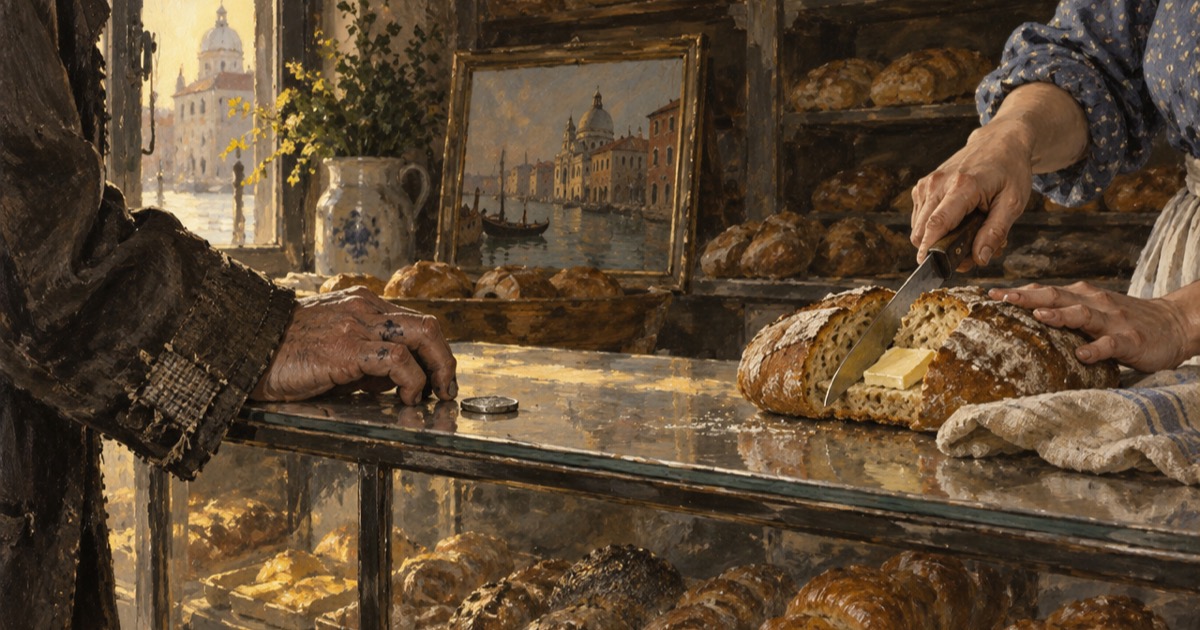
In O. Henry’s story “Witches’ Loaves,” collected in Sixes and Sevens (1911), Miss Martha Meacham keeps a little bakery on the corner. She is forty. Two or three times a week, a customer comes in: a middle-aged man in spectacles with a brown beard trimmed to a careful point. His clothes are worn and darned, but he is neat and polite, always buying two loaves of stale bread for the price of one fresh loaf.
One day she sees a stain on his fingers. That settles it for her:
“She was sure then that he was an artist and very poor.”
— O. Henry, “Witches’ Loaves,” Sixes and Sevens (1911) (Wikisource)
Out of that one stain, she builds him a life. She pictures him painting in a garret and chewing his dry crust in the cold. Sitting down to her own supper of chops and jam, Miss Martha wishes he could share it.
A test he passes without knowing
She wants proof, so she sets a Venetian painting she bought at a sale behind the counter. He glances at it and says the perspective is not true. Only an artist, she decides, could see that at a glance.
He starts to look thinner to her. She longs to add something good to his bread, but she does not dare. Artists are proud, she thinks. Instead, she starts wearing a blue-dotted silk blouse behind the counter.
Then one morning a fire engine clangs past. He turns to the door to look. Miss Martha slits both stale loaves with a bread knife, presses a generous amount of fresh butter inside, and wraps them up before he turns back. Butter carries no message, she tells herself, so nothing improper has happened. All day she pictures him at his easel, finding her gift.
The man who walked back in
He comes back furious. A young man from his office drags him out and then returns to explain. The customer is an architectural draftsman named Blumberger. For three months he has been drawing a plan for a new city hall, a prize competition. A draftsman draws in pencil first and then rubs the pencil lines out with stale bread crumbs. The butter has ruined the plan.
Miss Martha goes into the back room and takes off the silk blouse.
Care for someone who was never there
Her kindness was real, and so was the loneliness behind it. But the butter went to a painter in a garret, and the painter existed only in her head. The man at the counter had an actual reason for buying stale bread. She saw him two or three times a week and could have asked him what it was. She never did. A question might have dissolved the artist, and the artist was the one she cared for.
My Thursday customer has a coat, a can of soup, and a cat. Everything else I added on my own, and I added it with some tenderness. I am not sure the coupon was meant for him.
Of the life I gave him, which part did he actually show me, and which part did I need him to have?
Epimelea is an app built around the existential school. The conversation carries over from one meeting to the next. The archive is encrypted on the device and belongs to the person who wrote it.
About the app: an AI therapist for long-term therapy
This page is about a school of psychotherapy. It is not medical advice and not emergency help. If you are in danger right now, contact your local emergency number, or find a helpline in your country at findahelpline.com.

