Why reading about symptoms feels like finding myself
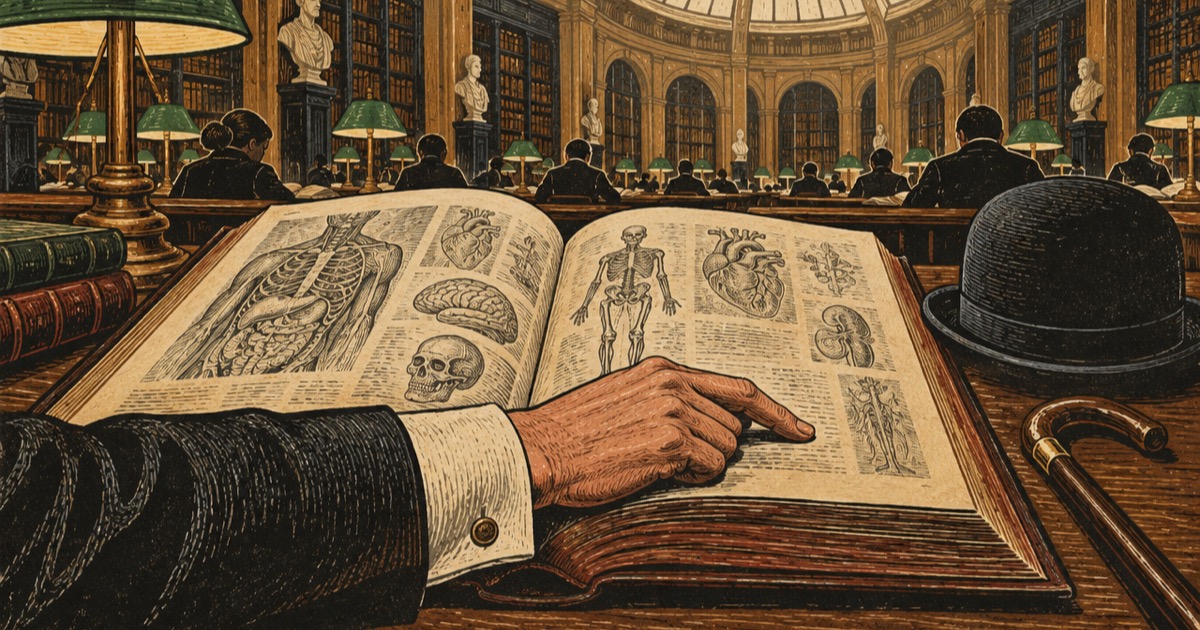
It usually begins with a single line in an article. A specific kind of tiredness, or a pain described with just enough detail to feel personal, leads from one paragraph to another page, and then to a forum thread from a decade ago. By the end of the night, the list matches your life.
In the morning, the behavior seems ridiculous. At night, it feels like being seen.
The reading room
Jerome K. Jerome captured this exact moment in the first chapter of Three Men in a Boat in 1889, where his narrator visits the British Museum to check on a minor complaint. He opens a medical text and searches alphabetically. Ague, cholera, diphtheria: he identifies each condition within himself. He reaches the end of the alphabet with one exception.
“I plodded conscientiously through the twenty-six letters, and the only malady I could conclude I had not got was housemaid’s knee.”
— Jerome K. Jerome, Three Men in a Boat, Chapter I, J. W. Arrowsmith, 1889
The joke could stop there. Jerome takes one more step, which gives the chapter its strongest line.
“I felt rather hurt about this at first; it seemed somehow to be a sort of slight.”
— Jerome K. Jerome, Three Men in a Boat, Chapter I, J. W. Arrowsmith, 1889
The one missing illness brings no relief. He feels offended, as if the book had excluded him.
A mirror with one blank space
Read this way, the book functions less as a catalogue of diseases and more as a mirror. Every entry poses the same question: is this you? Each confirmation moves the reader closer to a complete self-portrait, and the gap at housemaid’s knee disrupts that image.
This is why the scene remains effective. Few people who search for symptoms at midnight would say they want to be ill. But the act of reading pulls forward on its own. Each match feels like an accurate description, perhaps more accurate than anyone has offered in a while. A page that lists what you feel treats your experience seriously, line by line, without interruption.
Jerome summarizes the afternoon in two sentences.
“I had walked into that reading-room a happy, healthy man. I crawled out a decrepit wreck.”
— Jerome K. Jerome, Three Men in a Boat, Chapter I, J. W. Arrowsmith, 1889
Nothing happened to his body between the library door and the street. What changed was the narrative he carried out with him. The book never mentioned him specifically. It offered a shape, and he stepped into it.
Turning the next page
The search history from that night shows where attention went. It does not reveal what the reader was seeking underneath: a name for a vague feeling, proof that the feeling is real, a reason to be taken seriously, or a way to end the uncertainty.
When I open one more description of an illness, what am I hoping to find there?
Epimelea is an app built around the existential school. The conversation carries over from one meeting to the next. The archive is encrypted on the device and belongs to the person who wrote it.
About the app: an AI therapist for long-term therapy
This page is about a school of psychotherapy. It is not medical advice and not emergency help. If you are in danger right now, contact your local emergency number, or find a helpline in your country at findahelpline.com.


The first two meetings are free.