Why do my married friends make me feel like an outsider?
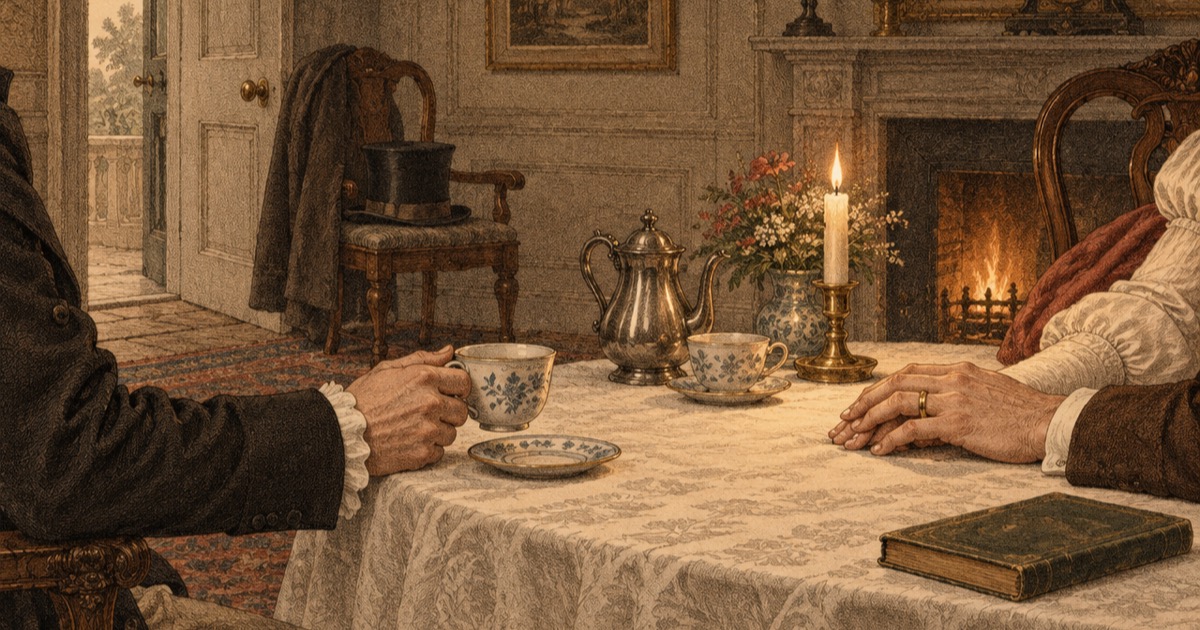
Your oldest friend and his wife invite you for dinner. The evening is polite. She asks about your work, passes the bread, and at some point they exchange a glance over a joke you missed. The mood shifts. You drive home and cannot identify what went wrong. Your apartment feels quieter than usual.
A list kept for comfort
Charles Lamb remained unmarried for his life. He lived with his sister Mary for most of that time. In 1811, he published “A Bachelor’s Complaint of the Behaviour of Married People,” which later appeared in Elia (1823). The opening lines state the purpose of the essay. Lamb recorded “the infirmities of Married People” to console himself for the joys he was told he had missed, a record kept by someone who needs the comfort it provides.
Too loving
What offends him is their affection. They do not conceal their preference for each other. A guest cannot sit with them without being shown that he is not the preferred person. He knows this already. He does not need it repeated:
“It is enough that I know I am not: I do not want this perpetual reminding.”
— Charles Lamb, “A Bachelor’s Complaint of the Behaviour of Married People”, Elia (1823); The Works of Charles and Mary Lamb, vol. 2, ed. E. V. Lucas, p. 144 (Project Gutenberg #10343)
The grievances are small. A new bride’s contented face. A comment about oysters he was told he could not judge as an old bachelor, and a wife who calls her husband’s friend a wit and seems disappointed in him. None of these stands as a formal complaint. Lamb knows this. He writes them down anyway, with the comic care of a man describing a splinter, though the essay becomes more serious when it addresses the friend he knew before the wedding.
The old friend and the new house
If you were close to the husband before courtship was even considered, Lamb warns, your position is precarious. Within a year, “you shall find your old friend gradually grow cool and altered towards you.” Old friendships must be brought in and re-stamped, like coins from an earlier reign. He is a rusty piece of metal in these new mintings.
The wife, though Lamb grumbles at her, arranges the new house as anyone would. The old friend is one item that must find a place. Lamb feels himself moved from shelf to shelf. Read slowly, the essay is not really about the couple.
What the house shows
Every complaint points back to the man making it. Their tenderness reminds him that nobody has chosen him. His friend’s new caution reveals how much of his own life rested on that one friendship, while Lamb keeps the reader laughing until it becomes plain where it hurts.
Feeling like an outsider in a married friend’s home may have little to do with what they do. Their kitchen, their shared glance, the way she says “we” can act like a lit window at night. You see your own room reflected in it.
What do I see in their house that I do not let myself think about in mine?
Epimelea is an app built around the existential school. The conversation carries over from one meeting to the next. The archive is encrypted on the device and belongs to the person who wrote it.
About the app: an AI therapist for long-term therapy
This page is about a school of psychotherapy. It is not medical advice and not emergency help. If you are in danger right now, contact your local emergency number, or find a helpline in your country at findahelpline.com.

