Why do people keep setting me up against the new colleague?
A new analyst started on my team in September. He sits two desks away, and we get along fine. We have had lunch twice. Within a week, people began making jokes. “Better watch your back.” “So who’s getting the promotion, you or him?” When he presented his first report, someone leaned over and whispered, “Round one to the new guy.” I have no complaint against him, and as far as I know he has none against me. Yet everyone seems to be waiting for us to go at each other, and I have started to feel I owe them a show.
A dragon on the Downs
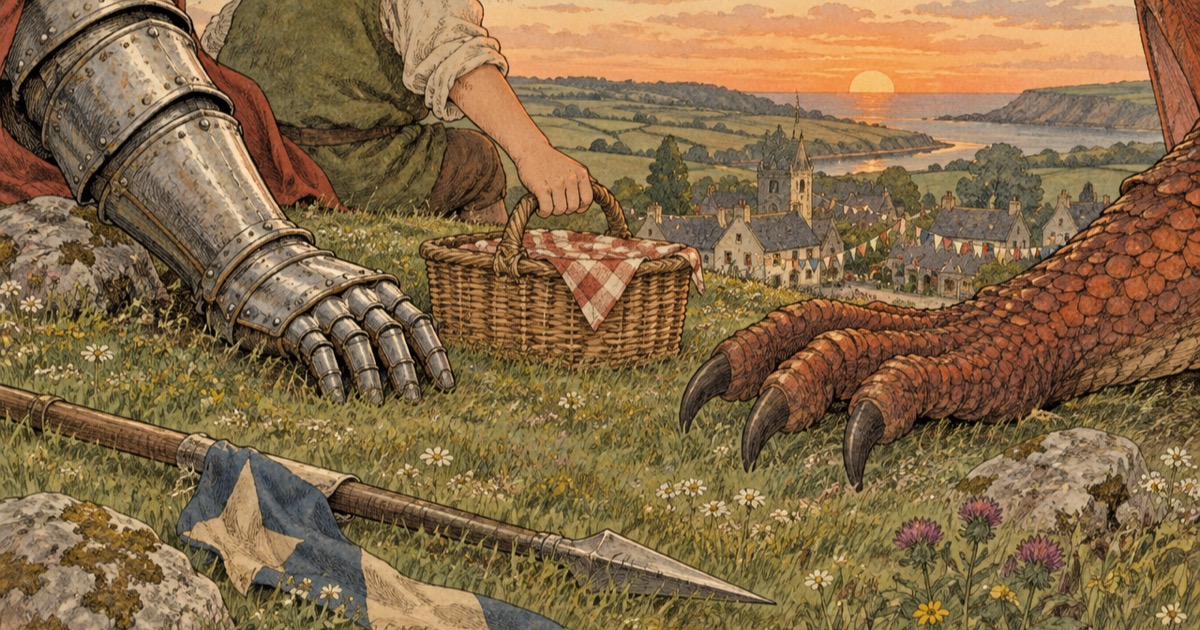
Kenneth Grahame’s story “The Reluctant Dragon” is set in a quiet stretch of English hills. A dragon works his way up from underground and settles in a cave above a village. He is lazy by his own admission. He likes the view and the sunsets, and he writes verses, sonnets especially. A shepherd’s son, called only the Boy, becomes his friend and spends his evenings on the hill, listening to the dragon’s old stories.
The village learns about the dragon and talks about him in the tavern every night. The villagers are frightened but also proud, for a dragon of their own is a feather in the village’s cap. Still, everyone agrees that this sort of thing cannot go on. Not even a hen-roost has suffered, Grahame notes, but nobody counts that. He is a dragon, so he must be fought.
Then St. George rides into the village. Carpets hang from the windows, the church bells ring, and a boy in the crowd tells the dragon’s friend what everyone is thinking: there is going to be a grand fight.
Nothing to fight about
The Boy runs up the hill with the news. He is half delighted himself. He tells the dragon that he has to fight St. George sooner or later, because one is a saint and the other a dragon. The dragon answers:
“I can’t fight and I won’t fight. I’ve never fought in my life, and I’m not going to begin now, just to give you a Roman holiday.”
— Kenneth Grahame, “The Reluctant Dragon,” Dream Days (London and New York: John Lane, The Bodley Head, 1902), p. 174 (Wikisource)
He is no coward. He says plainly what he will not do, and he says why. Nor does he leave. He likes the place and means to stay. What he refuses is the part the village has written for him.
Down at the inn, St. George has spent the evening hearing tales of the dragon’s crimes. He grants that they were rather highly colored. The Boy tells him what he knows: the dragon is a good one, a friend, and the villagers will cheer for any fight at all. They are already betting on it, six to four on the dragon.
So the Boy takes the saint up the hill to meet the dragon. Each is supposed to be thirsting for the other’s blood. They are introduced and make polite conversation. When St. George suggests they simply fight it out, the dragon calls it all nonsense, conventionality and popular thick-headedness. There is nothing to fight about, he says, from beginning to end.
A fight on agreed terms
Neither of them pretends the crowd isn’t there. The village wants its fight, and St. George cannot simply ride off. So they settle on terms. The dragon will ramp and breathe fire, and St. George will spear him under the neck, in a spare spot among the folds of thick skin, where it will not hurt. Next morning the whole village climbs the Downs in Sunday clothes, with baskets, and gets its spectacle. Afterward everyone goes down to a banquet, the saint, the dragon and the Boy among them.
The village got its fight, and nobody was hurt. The two in the middle played their parts for the people watching and never became enemies.
Whose quarrel
The villagers are not fools. They are frightened and proud, and a dragon gives the tavern something to talk about. The Boy wants his fight too, and he loves the dragon. Everyone around the saint and the dragon wants a contest. Only the two of them don’t.
At my desk, the jokes have gone on for two months. My colleague hears them too. Neither of us has said anything about it to the other. When someone calls his report “round one,” I notice myself checking whether I lost.
Whose quarrel is this, if he and I have nothing to quarrel about?
Epimelea is an app built around the existential school. The conversation carries over from one meeting to the next. The archive is encrypted on the device and belongs to the person who wrote it.
About the app: an AI therapist for long-term therapy
This page is about a school of psychotherapy. It is not medical advice and not emergency help. If you are in danger right now, contact your local emergency number, or find a helpline in your country at findahelpline.com.

