Why does every small job at home turn into a huge drama?
It begins with one shelf. I claim I can handle it in ten minutes. Then someone hunts for the drill, another person holds the level, and the children run back and forth for screws, and eventually for the correct ones. By nightfall, the shelf is installed, slightly askew, and everyone looks exhausted. I feel fine. In fact, I feel quite good.
The picture and Uncle Podger
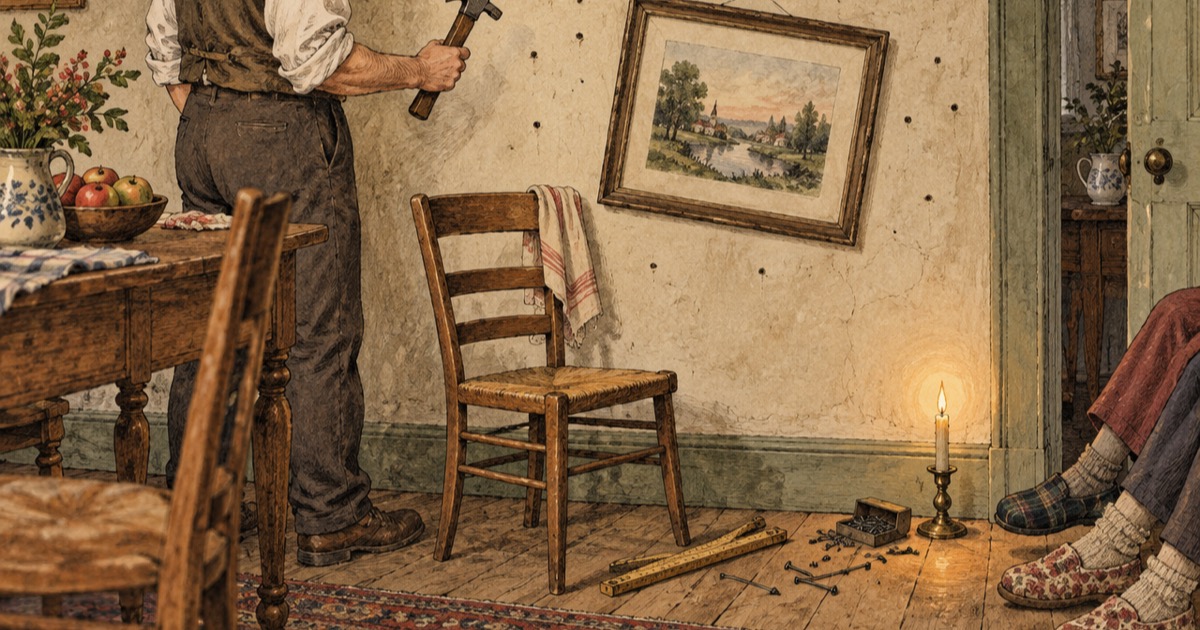
In chapter III of Three Men in a Boat (1889), Jerome K. Jerome describes his Uncle Podger. A framed picture arrives and sits in the dining room. Aunt Podger asks what to do with it. Uncle Podger removes his coat.
“Oh, you leave that to _me_. Don’t you, any of you, worry yourselves about that. _I’ll_ do all that.”
— Jerome K. Jerome, Three Men in a Boat, chapter III (Project Gutenberg #308)
Within a minute, he sends the maid out for nails and a boy after her to specify the size. One son fetches the hammer while another brings the rule, and a neighbour is asked for a spirit level. Aunt Maria holds the candle. He drops the picture, cuts himself on the glass, and loses his coat with the handkerchief inside. Then the nail vanishes, then the hammer, then the pencil mark on the wall.
Everyone else
Jerome counts the helpers: two hold the chair, a third holds Uncle Podger on it, a fourth hands up the nail, and a fifth the hammer. Uncle Podger hits his thumb and drops the hammer on someone’s toes. Aunt Maria says that next time she would like a week’s notice so she can stay with her mother. He tells her they all make a fuss over everything and that he likes doing a small job of this sort.
He means it. Around midnight, the picture hangs crookedly, and the wall looks raked; the family is dead beat and wretched, all except Uncle Podger. He admires his work.
What “I’ll do it myself” can mean
Uncle Podger is not pretending; he is happy. He never asked anyone to suffer, yet he could not have done it alone. His “leave that to me” gathered the whole house around him. The job was small. What he enjoyed was the evening itself, with everyone busy around him.
So who in my house actually needs me to be the one who hangs the picture?
Epimelea is an app built around the existential school. The conversation carries over from one meeting to the next. The archive is encrypted on the device and belongs to the person who wrote it.
About the app: an AI therapist for long-term therapy
This page is about a school of psychotherapy. It is not medical advice and not emergency help. If you are in danger right now, contact your local emergency number, or find a helpline in your country at findahelpline.com.

