Why does my conscience bother me whatever I do?
A friend asks for help moving on Saturday. You agree, and the week is filled with guilt over the family time lost. Another friend asks, and you refuse. Now you feel guilty toward them. You try to determine which response was correct. Both feel wrong.
A visitor in the parlour
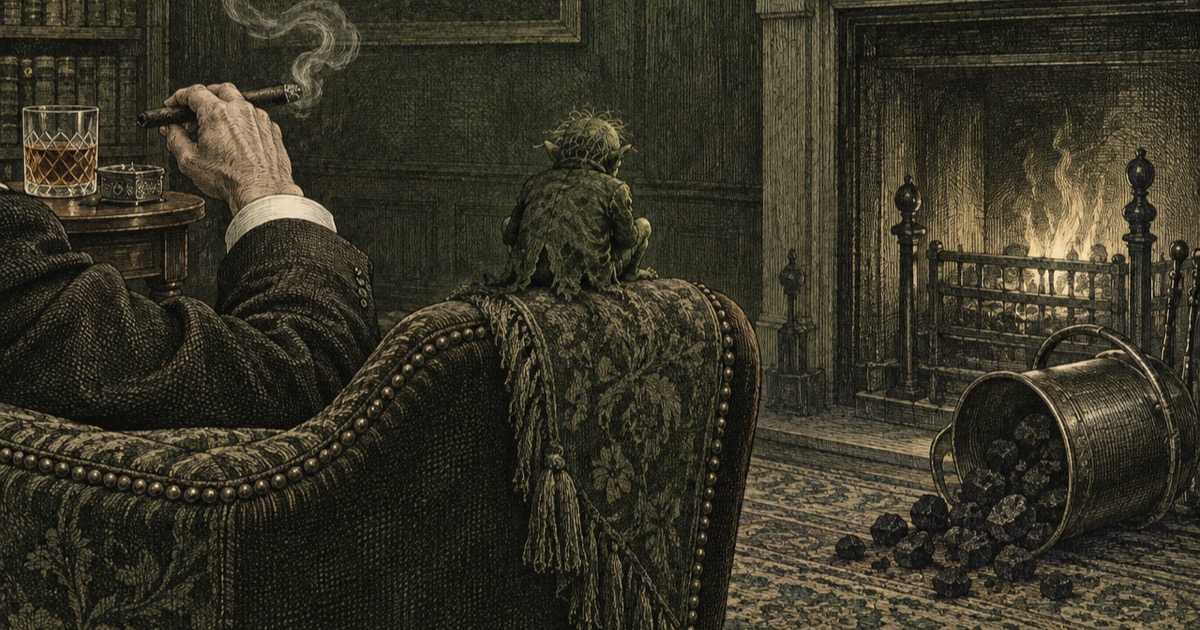
In 1876, Mark Twain published "The Facts Concerning the Recent Carnival of Crime in Connecticut" in The Atlantic Monthly. The narrator is at home, smoking, when a small creature, no more than two feet high and covered in fuzzy, greenish mould, enters. It lists his wrongs.
"Well, I am your Conscience!"
— Mark Twain, "The Facts Concerning the Recent Carnival of Crime in Connecticut", The Atlantic Monthly, June 1876 (Project Gutenberg #3183)
The tramps
The narrator does not ask for forgiveness. He asks for a rule. He reviews the tramps who came to his door. He lied to one and suffered. He told another the plain truth and gave him nothing, suffering all day that he had not eased him off with a kind lie. He fed one and was called a false citizen. He gave work to one and refused it to another, and was blamed in both instances. "Is there any way of satisfying that malignant invention which is called a conscience?"
The dwarf laughs. It can whisper a word over any act and make it feel like meanness. Why does it do this? "Well, WE like it; that suffices."
Where the pelting goes
The dwarf mentions something easily missed under the jokes. When the narrator was a boy, his conscience was seven feet tall. It enjoyed hammering him over certain pet sins so much that it overdid it, causing him to rebel. In those spots, the conscience went callous, like shark-skin. On smoking, and on eighty, or maybe ninety, other vices, it now simply falls asleep.
A conscience that blames everything wears itself out on small and doubtful matters, like whether he was kind enough to a tramp. Where it once had something real to say, nobody listens anymore.
Twain ends the story as farce. The narrator catches the dwarf, tears it to pieces, and sets off on a cheerful spree of crime.
Two kinds of voice
When guilt follows both yes and no, it stops providing information about either choice. It becomes noise that sounds the same over every decision. Somewhere under it may lie one thing actually done, and that one deserves to be heard.
What is my conscience blaming me for in earnest, and what is it only repeating out of habit?
Epimelea is an app built around the existential school. The conversation carries over from one meeting to the next. The archive is encrypted on the device and belongs to the person who wrote it.
About the app: an AI therapist for long-term therapy
This page is about a school of psychotherapy. It is not medical advice and not emergency help. If you are in danger right now, contact your local emergency number, or find a helpline in your country at findahelpline.com.

